

(And Why It Matters More Than You Think)
Most hair problems don’t start with styling.
They start in the shampoo bowl.
Breakage. Persistent frizz. Scalp irritation. Curls that won’t behave the way they used to. Hair that feels fine one day and impossible the next. These issues are often treated with more products, stronger products, or trend-driven “fixes,” but the root cause is usually much simpler.
The foundation matters.
At Wicked Hues, every educational styling appointment starts the same way: by slowing down and making sure hair is being washed effectively, not just habitually.
Because if the foundation isn’t right, everything that comes after it has to work harder to compensate.
Why “Just Shampooing” Isn’t So Simple
Most people were never actually taught how to wash their hair. They were handed a bottle, given vague instructions, and left to fill in the gaps on their own.
Over time, habits form. Some are harmless. Others quietly create problems that don’t show up until much later.
Common issues we see traced back to washing habits include:
- Product buildup that prevents moisture from penetrating
- Hard water residue that leaves hair dull or brittle
- Scalp irritation caused by incomplete cleansing
- Breakage caused by tension on wet hair
- Conditioner masking damage instead of revealing it
None of these are moral failures. They’re just missing information.
That’s why we start here.
What “Clean” Hair Actually Feels Like
One of the most important things we teach clients is how to feel what’s happening, not just follow steps blindly.
Truly clean hair (before conditioner) should feel:
- slightly rubbery
- a little spongy
- free of slickness or coating
If conditioner is doing all the detangling work, it can hide split ends and damage that need to be addressed. Clean hair tells the truth.
When you know what clean hair feels like, you can:
- use the right amount of product
- adjust instead of overcorrect
- tell when something isn’t working anymore
That awareness alone prevents a lot of long-term damage.
Why Water Matters More Than Shampoo
One of the biggest misconceptions in hair care is that shampoo does the cleaning on its own.
It doesn’t.
Water activates surfactants. Without enough water, shampoo can’t do its job evenly or gently. That’s why distribution, saturation, and technique matter more than using a “stronger” formula.
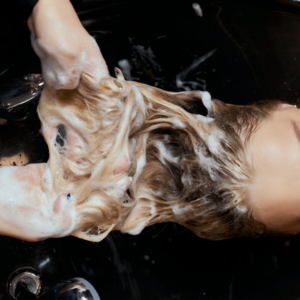
In the salon, we spend time making sure hair is thoroughly wet, properly lathered, and cleansed evenly across the scalp. Not rushed. Not scrubbed aggressively. Not drowned in product.
Just intentional.
Watching It Done, Step by Step
Below is a real-time walkthrough filmed during an educational appointment, where a client is guided through washing their own hair while holding a mirror.
There are no jump cuts, no hype, and no shortcuts. This is how we actually do it in the salon, and how we teach clients to replicate it at home.
This process usually takes about 30 minutes in the shampoo bowl during an appointment, because that’s what it takes to undo years of misinformation and replace it with something sustainable.
Why We Take This Approach
We aren’t interested in trends that promise instant results and create long-term problems.
We focus on:
- understanding what hair has already lived through
- working with its current condition instead of forcing it
- building routines that support hair health over time
That starts with washing.
When washing is done well:
- styling becomes easier
- products work the way they’re supposed to
- curls and waves show up more consistently
- scalp issues calm down instead of escalating
And most importantly, clients stop feeling like they’re “bad at hair”, or “just have bad hair”.
If This Feels Different, That’s Intentional
If you’re tired of hyped routines, conflicting advice, and feeling like every solution creates a new problem, you’re not alone.
This approach is slower. It’s quieter. It’s more observant.
And it works because it’s built on fundamentals, not trends.
If you’d like to experience this kind of education and care in person, you can explore our first appointment process and educational styling sessions through the salon.
If not, this foundation alone can still change how your hair behaves over time.
Either way, starting at the shampoo bowl is rarely the wrong move.
- Not All Frizz Is Caused By Humidity – And That Changes How You Treat It
- Dense Curly Hair Neglected for Two Years: A Real Client Transformation.
- Plastic-Free Isn’t the Whole Story.
- 5,000 Years of Hair Washing
- Why New Orleans Water Is Quietly Wrecking Your Scalp (And What to Do About It)
