

A deep dive into one of the most misunderstood concepts in the curl community. Why the distinction matters more than you think.
If you’ve spent any time in curl communities online, you’ve probably come across porosity as though it were a personality type. Low porosity. High porosity. A fixed characteristic of who your hair is.
But here’s what most of those conversations leave out: high porosity is not a inherent hair type. It’s a condition. And more often than not, it’s the result of damage.
That distinction might sound like semantics. It isn’t. Because when you believe your hair is simply built a certain way, fundamentally flawed, permanently difficult, you stop looking for a different outcome. You accept the damage as identity. And in doing so, you often can’t recognize health when it’s finally standing in front of you.
This post is about changing that.
First: What Is Porosity, Actually?
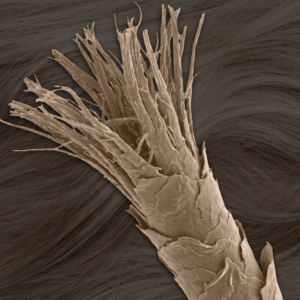
Porosity refers to your hair’s ability to absorb and retain what’s put into it. It’s determined by the state of your cuticle layer, the outermost part of the hair shaft, made up of overlapping scales, like shingles on a roof. It’s also determined by your lipid layer, a secondary protective layer just underneath that helps prevent water from breaking apart the bonds inside the hair, like the weatherproofing on your door.
High porosity hair has cuticles that are raised, open, or damaged, maybe also a missing or deteriorated lipid layer. What goes in escapes just as fast. Hair feels dry almost immediately after washing. Products seem to absorb but provide little lasting benefit. Frizz is constant. Tangles appear out of nowhere. Color washes out too quickly.
Sound familiar? There’s a reason for that.
Under the Cuticle: What’s Actually Happening
Think of a healthy hair strand like a new roof with tightly overlapping shingles, and a solid weatherproofing layer. Rain hits it, beads up, and runs off cleanly. The interior stays protected.
Now imagine that same roof after years of harsh weather, or a bad renovation. The shingles are cracked, lifted, or missing entirely. That weatherproofing strip is worn down and is no longer solid. Water gets in everywhere. The interior is exposed. And no amount of cleaning the surface fixes the structural problem underneath.
That’s high porosity damage in a nutshell. The cuticle has been compromised by chemical services, heat, mechanical stress, environmental exposure, or simply years of products that stripped more than they gave back. That lipid layer has been slowly eaten away. The hair shaft is now porous in the way a damaged structure is porous: open to everything, holding onto nothing.
Common causes of high porosity damage include:
- Chemical services: bleach, color, relaxers, perms
- Repeated heat styling without protection
- Harsh shampoos that strip the hair’s natural oils (sometimes using detergents harsher than sulfates)
- Product buildup that coats and suffocates the strand over time
- Environmental stressors like sun exposure, hard water, and chlorine
- Hard water or chlorine creating a chemical reaction to your next hair dye
None of these make you careless or uninformed. They make you human. Most of us spent years following advice that wasn’t designed for our hair type, or any hair type, really.
The Problem With Accepting It As Permanent
When high porosity gets discussed as a permanent hair type rather than a treatable condition, people adapt to it instead of addressing it. They build entire routines around managing the symptoms: constant deep conditioning, protein treatments stacked on protein treatments, layer after layer of product trying to fill a gap that can actually be closed.
The products work temporarily. But without addressing the underlying damage, the hair returns to its depleted state quickly. And so the cycle continues: dry, product, temporarily better, dry again. Nothing ever quite right.
There’s something deeper happening in that cycle too. When you’ve been told, or have come to believe, that this is simply your hair, you stop imagining an alternative. The frizz, the dryness, the unpredictability: these become your baseline. Your normal. And when your hair finally starts to behave differently, to retain what’s put into it, to clump and define and move with intention, you might not recognize it. You might even distrust it.
Healing can look unfamiliar. That doesn’t make it wrong.
What Restoration Actually Looks Like
High porosity damage is not permanent. The hair shaft that exists right now may be compromised, but new growth emerges healthy. And with the right approach, even existing strands can be meaningfully restored.
The goal is to support the cuticle in lying flatter and retaining what’s put into it, and mending or patching the holes in the lipid layer. This requires a multi-pronged approach that works with the hair’s chemistry rather than against it.
Protein Retention
Hair is primarily made of keratin protein. When the cuticle is damaged, that protein structure has gaps. The hair shaft loses its ability to hold onto what it needs, not because it’s inherently deficient, but because the damage has compromised its structural integrity. Targeted protein support works by temporarily filling those gaps and smoothing the cuticle layer, giving the strand a chance to behave as it was designed to. This is a longer conversation than one blog post can hold, and one I’ll go deeper on separately. For now: protein retention is the foundation. Everything else builds on it.
pH-Aware Products
Hair and scalp thrive in a slightly acidic environment (around 4.5 to 5.5 on the pH scale). Many drugstore products are alkaline, which lifts the cuticle further. Using pH-balanced products, particularly conditioners and finishing treatments, actively encourages the cuticle to close and seal.
Integrity-First Formulas
Not all curl products are created equal, and many of the most heavily marketed ones are formulated for the look of curl definition without regard for the long-term health of the strand. Products that prioritize hair integrity focus on building from the inside out: strengthening the cortex, supporting the cuticle, and reducing the inflammation and oxidative stress that compound damage over time.
This is why the products in my salon aren’t chosen for their marketing or their packaging. They’re chosen because I understand what they’re doing at a structural level, and because I use them myself.
When Healthy Hair Feels Like a Stranger
When hair begins to restore its health, it doesn’t always look the way you’d expect. In fact, it can look completely unfamiliar, and for people who have spent years managing damaged hair, that unfamiliarity can feel like something going wrong.
Healthy fine curls clump. They group together into defined spirals rather than puffing out with frizz to fill the space. This creates what looks like more scalp visibility, but is actually curl formation working correctly. The hair that was once spread diffusely across your head is now gathering into intentional shape.
Healthy curls also behave differently at home than they do in the salon, especially in the early stages of restoration. New products, new techniques, new environmental conditions: your hair is responding to all of it simultaneously. The first few weeks of a new routine are a conversation between you and your hair. Not a final verdict.
If your hair looks or feels different than you expected after working with integrity-first products and a stylist who understands curl structure, I’d ask you to sit with it for a month before drawing conclusions. What your hair is becoming may simply need time for you to recognize it.
Why This Matters Beyond the Hair
I wrote this post because I see it regularly: people who arrive carrying years of a story about their hair being difficult, unmanageable, or fundamentally problematic. That story shapes everything. The products they buy, the stylists they trust, the outcomes they allow themselves to hope for.
And sometimes, when we’ve held a belief about ourselves long enough, we can’t recognize the evidence that contradicts it. Even when it’s right in front of us.
Your hair is not broken. It’s been through something. Those are different things. And the path forward isn’t managing damage forever. It’s understanding what happened, addressing it with intention, and giving your hair the space to show you what it’s actually capable of.
It might surprise you.
- Not All Frizz Is Caused By Humidity – And That Changes How You Treat It
- Dense Curly Hair Neglected for Two Years: A Real Client Transformation.
- Plastic-Free Isn’t the Whole Story.
- 5,000 Years of Hair Washing
- Why New Orleans Water Is Quietly Wrecking Your Scalp (And What to Do About It)
- Not All Frizz Is Caused By Humidity – And That Changes How You Treat It
- Dense Curly Hair Neglected for Two Years: A Real Client Transformation.
- Plastic-Free Isn’t the Whole Story.
- 5,000 Years of Hair Washing
- Why New Orleans Water Is Quietly Wrecking Your Scalp (And What to Do About It)
