

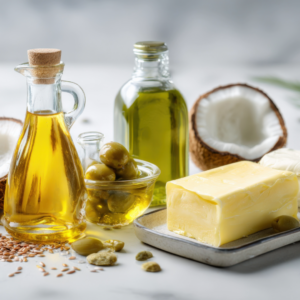
If you use coconut oil (or castor oil, shea butter, olive oil, argan oil, or any other raw oil) directly on your hair, there’s a good chance it’s the reason your hair feels dry.
I know that’s not what you wanted to hear. The internet told you these oils were natural, protective, and safe. It makes sense that you believed it. Nobody was trying to deceive you on purpose.
But after ten years in this industry, seeing the result of raw oils walk through my door on a consistent basis, I need to give you the full picture. Not the version that sells pantry ingredients as miracle cures. The version that explains the chemistry.
First, let’s talk about water.
Before we get to oils, you need to understand what water is actually doing to your hair. This is the foundation of why oils are a problem.
Water is a corrosive substance. We know this. Water carved the Grand Canyon. Not the wind, nor the heat.
Your hair sits at a pH of 4.5 to about 5.5. Water sits at a 6 to 7. That pH mismatch matters more than most people realize. When water that isn’t pH balanced to your hair sits on your strands, it opens the cuticle and begins working its way through your hair’s natural lipid layer. That lipid layer is the protective coating underneath the cuticle that keeps your hair flexible, strong, and intact.
Once that cuticle is open, a few things happen.
The hydrogen bonds that give your hair its shape break every time your hair gets wet. That’s normal and temporary; they reform as your hair dries. But the salt bonds can also be disrupted by the pH imbalance. And with the cuticle open, free radicals can get in and cause more permanent bond breakage. Every single wash, you lose a small amount of natural protein. That’s just the reality of having hair that gets wet. (We go deeper on the basics of protein loss and what your hair actually needs here.)
This is why I consistently recommend diffusing over air drying. The longer your hair sits in that open, fragile, wet state, the more cumulative damage occurs. Drying in 20 to 30 minutes with a diffuser is meaningfully different from letting water slowly evaporate over four-plus hours. And in the swampiness of our New Orleans climate? Water will never completely leave the hair without a little dry hot air.
All of this, every wash and every air dry, is cumulative. It adds up over time.
Why oils make this worse
Oils cannot evaporate off the hair the way water does.
Read that again. Oils cannot evaporate off the hair the way water does.
Water, even though it’s damaging while it sits there, eventually leaves. It evaporates. Your hair has a chance to close back up, to recover, to exist in a dry state again.
Oil doesn’t do that. Not as fast, not without added heat. And adding that heat fries your hair.
When you apply a raw oil to your hair, you are keeping your hair in a prolonged wet-adjacent state where the cuticle stays disrupted and the lipid layer is under continued stress.
And oil is a lipid. Your hair’s protective layer is a lipid. And lipids can degrade other lipids. So while water disrupts your lipid layer temporarily, raw oils work on it from a different angle: more corrosively, and for longer, because they don’t leave as fast at room temperature.
The result is a hair shaft that is increasingly compromised: open cuticle, degraded lipid layer, broken bonds, free radical exposure. And because your hair feels dry and brittle from being in this state, the instinct is to apply more oil to make it manageable. Which extends the wet state further ->causes more damage -> makes your hair feel drier -> makes you reach for more oil.
That cycle is what I see walking through my door. Hair that doesn’t feel like hair anymore.
Think of it like uncooked pasta. Dry, rigid, prone to snapping. The only time it feels manageable is when it’s wet. So you keep it wet. And wet hair is fragile hair.
This is also why so many people in the curl community have been misidentifying their hair as “high porosity” when what they’re actually dealing with is accumulating damage. If that sounds familiar, this post on high porosity vs. damage is worth reading alongside this one.
“But I’ve seen studies that say coconut oil is protective.”
You’re not wrong that those studies exist. But read them again, carefully.
The studies that show coconut oil as protective are testing it as a pre-wash treatment. Apply it, wait, then shampoo it out. The entire premise of that use case is that the oil is being removed.
And honestly? That use case is its own admission of a problem. If you need to coat your hair in oil before shampooing specifically to protect it from the shampoo, your shampoo is too harsh. You’re diluting a caustic product with oil to make it less damaging. The research isn’t saying oil is good for your hair. It’s saying oil can buffer the effect of a shampoo that really should have been better formulated to begin with.
It’s admitting that both things are a problem.
Nobody in the research is studying what happens when you apply raw oil to wet hair as a leave-in, let it sit indefinitely, reapply when your hair feels dry again, and repeat that pattern for six months. Nobody is studying the use of it as a post-conditioner “sealant”, a conditioning “mask”, or a “leave-in” treatment. Those use cases describe how most people are actually using these oils. But those aren’t in the literature. But it absolutely is in my salon. I see the result of it consistently.
There’s one more thing worth knowing about those studies. The hair being tested was harvested and stripped of its natural sebum before testing. That’s standard lab protocol. So the oil wasn’t being applied to hair that already had its natural sebum coating intact. It was applied to a controlled, stripped baseline that doesn’t reflect real hair on a real head.
Your scalp already produces its own protective substance: sebum. And sebum is not oil. It’s a complex biological mixture your body makes specifically for your hair and skin. Adding coconut oil on top of a head that’s already producing sebum isn’t replicating something natural. It’s layering a foreign lipid on top of a system that was already doing its job. And notably, your scalp produces sebum at the root. Most people are applying coconut oil along the mid-shaft and ends, where sebum rarely reaches naturally. A well-formulated serum can do a much better job of what you’re looking for.
This doesn’t mean I’m dismissing the research. It means the research and the real-world use case are describing two completely different things.
What about “natural” oils in hair products?
This is an important distinction.
A professionally formulated hair product can contain oils. Many great ones do. The difference is everything around that oil: the pH balance, the delivery system, the emulsification, the supporting ingredients that determine how much the hair absorbs and what happens to the rest.
A well-formulated serum made with oils is designed so your hair takes what it needs and the rest evaporates or rinses away. That’s intentional chemistry. That’s someone with a background in hair biology deciding what concentration, what carrier, what supporting cast makes that oil behave correctly on hair.
Raw oil from a jar has none of that. It’s just oil. No structure, support, or delivery system. No consideration of pH. Just a substance that will sit on and in your hair and not leave.
You don’t need a master’s degree in biochemistry to care for your hair well. You just need to trust the formulations of people who have one. This is actually the same reason most hair products aren’t working the way you expect them to: when products are built to work only on the surface, or when ingredients aren’t formulated with delivery in mind, they can’t do what you’re hoping for.
Think of it like baking. Eggs alone don’t make a cake. The right ratio of eggs to everything else in the right order, baked at the right temperature for the right amount of time, makes a cake. You can even substitute ingredients, but only if you understand how those substitutions affect the chemistry of the whole. A raw oil applied directly to hair is the equivalent of cracking an egg directly onto your dessert plate and calling it a soufflé. (This is also why homemade and small-batch hair products carry more risk than they might appear to.)
What recovery actually looks like.
If you’ve been using raw oils for a significant period of time, the reset is real and it takes time.
I have had clients who needed to strip their entire routine back to just a shampoo, a conditioner, and one styling product, and use only those things for six months straight, before their hair felt like their hair again. Before they could even identify what their hair actually does, how it behaves, what its real texture is. That’s how cumulative raw oil damage works. It doesn’t happen overnight. And it doesn’t resolve overnight either.
But it does resolve.
The path back isn’t complicated. How you wash matters enormously during this phase, and getting that right from the start makes the recovery faster and more consistent. It’s a matter of getting out of the cycle and letting your hair exist as hair for long enough to show you what it actually needs.
If you’re also dealing with buildup from months of product and oil layering, this post on why curl products can quietly cause damage covers what a proper reset and clarifying process actually looks like.
This isn’t your fault.
You were trying to take care of your hair. You were told oils were natural and safe and that “natural” meant better. That logic is understandable. It’s everywhere online.
But your hair has chemistry. And that chemistry doesn’t care whether something came from a coconut or a laboratory. It only cares whether what you put on it is compatible with how it works.
Raw oil is not a hair product. It’s an ingredient. And ingredients without context, without formulation, without chemistry, don’t behave the way finished products do.
If this post stings a little, I get it. Letting go of something you believed in is hard. But if you’ve made it this far, maybe this was the information you needed.
Your hair isn’t dry because it needs more “moisture.” It’s dry because it can’t get out of a wet state long enough to recover. It’s dry, because somewhere along the way, it’s lost more than 50% of its natural proteins, and the lipid layer can’t repair long enough to stop more from leaving.
Let’s fix that.
If you want to know what I actually recommend during a reset and why, that’s a conversation for your first appointment with me.
- Exploring Scalp Relief & Revival: Oily by Day Two, Flaky by Day Three: What I Actually Do About It
- Yes, You Can Ask Me Not to Talk. Here’s What Else You’re Allowed to Ask For.
- Diffusing Your Curls and Still Getting Frizz? Here’s What’s Actually Going Wrong
- Flaky Scalp? Here’s Why It’s Probably Not Dandruff (And Why Treating It Like Dandruff Makes It Worse)
- Not All Frizz Is Caused By Humidity – And That Changes How You Treat It
- Exploring Scalp Relief & Revival: Oily by Day Two, Flaky by Day Three: What I Actually Do About It
- Yes, You Can Ask Me Not to Talk. Here’s What Else You’re Allowed to Ask For.
- Diffusing Your Curls and Still Getting Frizz? Here’s What’s Actually Going Wrong
- Flaky Scalp? Here’s Why It’s Probably Not Dandruff (And Why Treating It Like Dandruff Makes It Worse)
- Not All Frizz Is Caused By Humidity – And That Changes How You Treat It
