

Is the No Poo Method Bad for Scalp Health? The Biology, Explained
If you’ve been wondering whether the no poo method is bad for scalp health, you’re asking the right question. The biology behind why cleansing matters, and why “no poo” isn’t the answer.
If you’ve tried going no-poo, or you’ve been stretching your washes as long as possible because someone in a hair forum told you shampoo was stripping your hair, you’re not wrong for trying. You were given information that sounded scientific, came from people you trusted, and made a certain kind of intuitive sense. I’m not here to make you feel bad about that.
But I am here to tell you what’s actually happening on your scalp. And once you understand the biology, the case for regular, effective cleansing becomes pretty hard to argue with.
This post isn’t about selling you on more product. It’s about giving you the actual science so you can make an informed decision, which is what I try to do with every client who sits in my chair.
Your Scalp Is Skin. It Behaves Like Skin.
This sounds obvious, but it gets lost in a lot of hair care conversation. The scalp isn’t some separate category of tissue with different rules. It’s skin. With all the same biological machinery as the skin on your face, your back, your forearms. It produces oil. It sheds dead cells. It hosts a microbial ecosystem. It has a protective acid layer that keeps the bad stuff out and the good stuff in.
The difference is density. The scalp has a higher concentration of sebaceous glands, the glands that produce oil, than almost anywhere else on the body. That density is part of what makes it such an effective environment for hair growth. It’s also what makes it uniquely prone to buildup when those glands aren’t managed properly.
Think of it this way: you wash your hands every day. No one tells you that’s stripping your skin’s natural oils and you should stop. The scalp is the same skin, doing the same things, producing the same outputs, just under a lot of hair.
What Sebum Actually Is, And What Happens When It Builds Up
Sebum is the oil your sebaceous glands produce continuously. It’s a waxy mixture of lipids, fatty acids, and wax esters, and it exists for good reasons: it lubricates the hair shaft, helps retain moisture, and provides some antimicrobial protection at the scalp surface. Sebum is not the enemy.
The problem is what sebum becomes when it’s not removed regularly.
It oxidizes.
Sebum left on the scalp doesn’t stay fresh. It breaks down, oxidizes, into irritating free fatty acids. These are documented chemical triggers for itch, inflammation, and scalp sensitivity. Research shows that itch severity measurably increases within 72 hours post-wash, directly correlating with sebum re-accumulation. That itchy scalp at day three or four isn’t in your head. It’s chemistry.
It traps everything.
Sebum is hydrophobic and sticky. It acts like a collection surface for everything that touches your scalp: dust, pollen, pollution particles, dead skin cells, styling product residue, hard water mineral deposits. In New Orleans specifically, where our water runs at roughly 138 parts per million of calcium and magnesium, mineral buildup on top of sebum is not a small problem. It’s why our Ultra Detox service exists. That compacted layer of sebum, minerals, and debris doesn’t wash off with water. It requires surfactants to emulsify and carry it away.
It feeds things you don’t want overpopulated.
This is the part that surprises most people.
What’s Actually Living on Your Scalp
Everyone’s scalp hosts a community of microorganisms. This is normal, healthy, and not cause for alarm. The problem comes when certain members of that community get more food than they should, which is exactly what happens when sebum accumulates.
Malassezia: the yeast behind dandruff
Malassezia is a naturally occurring yeast present on virtually every adult scalp. Under normal conditions, it’s a harmless commensal, it lives there, bothers no one, and keeps to itself.
When sebum builds up, Malassezia proliferates. It metabolizes sebum triglycerides and releases irritating free fatty acids, oleic acid being the primary offender, which penetrate the scalp surface, trigger inflammation, accelerate skin cell turnover, and produce the flaking and itch we call dandruff.
The thing to understand about dandruff:
It’s not a hygiene failure. It’s not dry skin. It’s a direct metabolic output of a yeast consuming the food you left out for it. The intervention isn’t a always or just “dandruff shampoo'” with harsh chemicals or that requires a prescription. The intervention is removing the food supply, which requires effective, regular cleansing. With either a clarifying or chelating shampoo, or a prescription from a dermatologist.
The mistake I see a lot of folks make is using that dandruff shampoo at the same frequency they had been washing their hair, at the same frequency that caused the problem in the first place. This is why they “have dandruff their whole lives.” Dandruff, if it is in fact dandruff and not just dry scalp, is to be treated like most fungi. Daily, sometimes twice a day, until it’s gone, and maybe even a couple weeks after that, to starve the fungus until it dies.
Demodex: the mites in the follicle
I know. Bear with me.
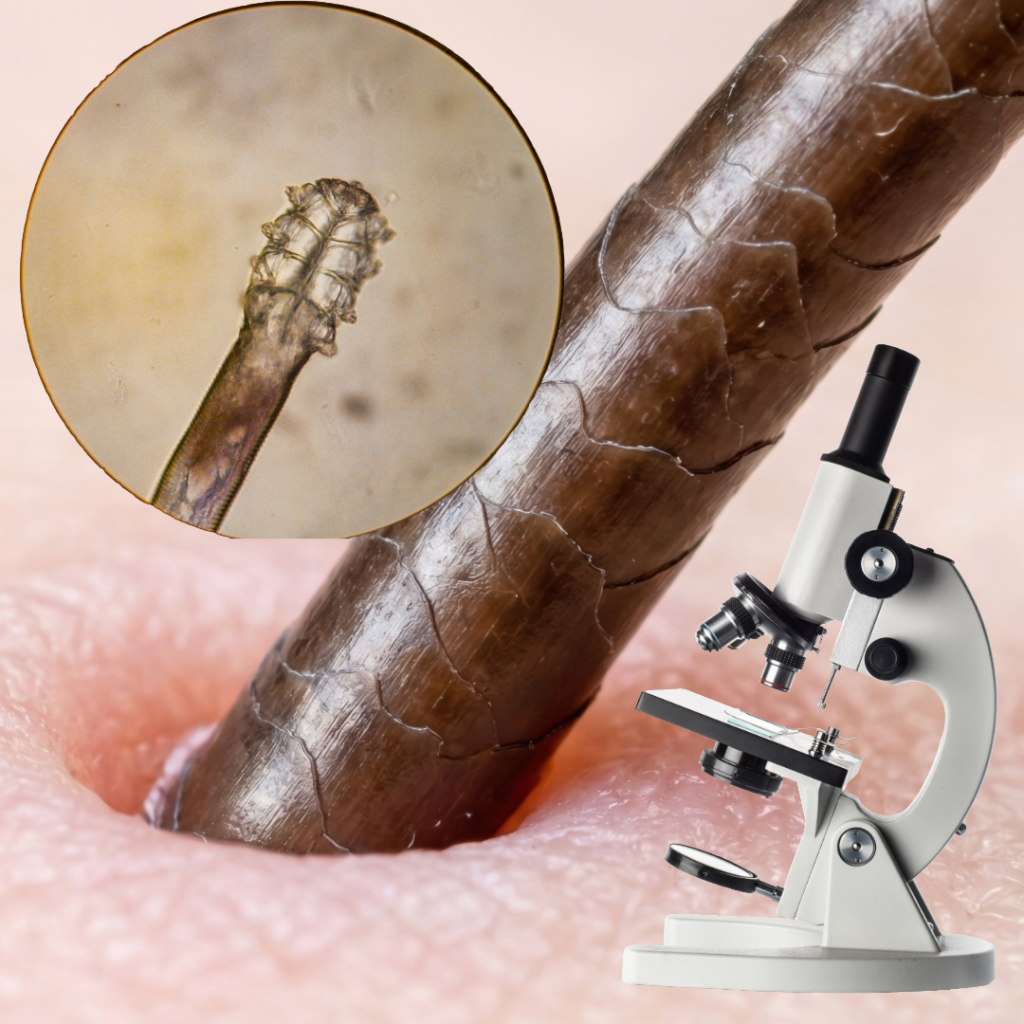
Demodex folliculorum and Demodex brevis are microscopic arachnids, tiny relatives of spiders and ticks. that live inside the pilosebaceous units of virtually every adult. They’ve been there since shortly after birth. In normal populations, they cause no symptoms and require no treatment.
When sebum accumulates, Demodex populations can get out of balance. They feed on sebum and dead skin cells. Their waste and decomposed bodies contribute to the inflammatory load around the follicle. When overpopulated, they’re associated with scalp folliculitis, itching, scaling, and in some cases hair loss. They also live deep enough in the follicle that surface-level oil cleansing, one of the popular no-poo alternatives, can’t reach them at all.
Reducing sebum through regular cleansing is the primary non-pharmaceutical way to keep Demodex populations in check. And yes, the scalp can act as a reservoir for these mites, which can migrate to the face, relevant for any client managing rosacea or persistent facial irritation.
I’m not telling you this to alarm you. I’m telling you because understanding what’s actually happening under the surface is the only way to make informed decisions about how you care for your scalp. Most people have never been told any of this.
DHT and the Follicle: The One Nobody Talks About
There’s a fourth thing happening at the follicle that almost never comes up in scalp health conversations, because it operates on a completely different timescale than everything above. Not days or weeks. Years.
DHT, dihydrotestosterone, is a hormone produced when an enzyme called 5-alpha reductase converts testosterone. Everyone produces it, regardless of gender. And in people with a genetic sensitivity to it, DHT binds to hair follicles and progressively miniaturizes them. Each growth cycle, the hair comes back a little finer, a little shorter. The follicle’s active growth phase gets shorter and shorter until eventually it stops producing hair at all and is replaced by scar tissue.
This is androgenetic hair loss. It’s the most common form of hair loss there is, and it’s been happening to humans for as long as humans have existed. Egyptian mummies show evidence of it. The Romans documented it. And for most of that history, nobody had any idea what was causing it, so treatments ranged from hippo fat to caustic compounds to scalp scarification, none of which touched the actual mechanism.
Sebum and DHT aren’t unrelated problems. Sebaceous glands are androgen-sensitive. Higher DHT activity tends to mean higher sebum production. And Malassezia, which is already feeding on that sebum, is found in higher concentrations on the scalps of people experiencing androgenetic hair loss. The chronic low-grade inflammation that Malassezia creates around the follicle doesn’t cause DHT-driven miniaturization, but it doesn’t help it either. A follicle fighting both a hormonal signal and a persistent inflammatory environment is under more stress than it needs to be.
I’m not saying washing your hair will stop genetic hair loss. It won’t. But keeping the scalp environment clean, the follicle opening clear, and the Malassezia population in check removes one layer of compounding stress from follicles that are already under pressure from a biological process they can’t opt out of.
The scalp problems we’ve covered so far, sebum oxidation, Malassezia, Demodex, and follicle occlusion, are problems that effective cleansing directly addresses. DHT is different. It’s hormonal, it’s genetic, and it operates beneath the surface in ways that washing alone can’t reach. But they share a home, and what you do at the surface matters for what’s happening underneath.
What can actually address DHT, without a prescription
Until pretty recently, the options for addressing 5-alpha reductase, the enzyme that creates DHT, were limited to pharmaceuticals. Finasteride is the most well-known, and it works by inhibiting that enzyme directly. It also comes with a side effect profile that makes a lot of people hesitant, and it requires ongoing use to maintain results.
What’s newer, and what most people haven’t heard of yet, is that specific botanical peptide complexes can inhibit 5-alpha reductase without pharmaceutical intervention. This isn’t marketing language dressed up as science. There’s a meaningful difference between an ingredient listed at trace concentration near the bottom of a label and one that’s been formulated as an active, delivered in a way that actually reaches the scalp. Eufora’s ScalpTherapy line, and the For Him line, are both built around exactly this mechanism.
The ProAmino Peptide Complex inhibits the 5-alpha reductase above and below the scalp surface. It also addresses sebum production directly, and slows sebaceous gland activity by up to 69%, which means less DHT fuel, less Malassezia food, and less follicle stress, all from the same product. The actives are delivered via nanoemulsion technology, which means they’re not just deposited on the scalp surface during washing. They continue releasing below the surface throughout the day.
This is not a miracle cure for genetic hair loss. Anyone telling you that a topical product will fully reverse miniaturization that’s already occurred is overselling it. But inhibiting the mechanism that drives the process, reducing the inflammatory environment that compounds it, and keeping the scalp clean and the follicles clear, done consistently, with the right formulation, is a meaningful intervention. It’s the most biologically complete approach to hair loss outside of a prescription, and it’s what I reach for when a client is dealing with thinning.
If you’re noticing more shedding, a widening part, or hair that seems to come back finer than it used to, that’s worth a conversation. Not a guess, not a Reddit thread. A conversation with someone who can actually look at your scalp, understand what’s driving it, and make a recommendation based on your specific situation.
Dead Skin Cells and the Follicle Opening
The scalp constantly sheds its outermost skin cells, a normal process called desquamation. Under healthy conditions, these cells shed, the follicle opening stays clear, and hair grows unimpeded.
When cleansing is insufficient, dead cells mix with sebum and compact into a dense layer around the follicle opening. This layer impedes follicle function. It contributes to the flaking that gets mistaken for dry scalp. And it creates a substrate, a food source, for the microbial populations we just talked about.
The follicle itself is where hair growth either happens or doesn’t. A clean, unoccluded follicle with healthy blood flow, adequate oxygenation, and a balanced microbial environment is the biological prerequisite for optimal hair growth. That’s not marketing, it’s basic follicle physiology.
Why the No Poo Method Falls Short
Now that we understand what the scalp is doing, we can look at why the most popular alternatives to shampoo don’t actually address the problem.
Water only
Sebum is hydrophobic, it literally repels water. A water rinse removes sweat, which is water-soluble, but leaves sebum entirely in place along with everything trapped in it. The oxidized fatty acids, the dead cells, the Malassezia food supply, the Demodex habitat, none of it moves. Water doesn’t interrupt any of the biological cycles above.
Oil cleansing
Lipids dissolve lipids. This is real chemistry. But the second step is the problem. Applied oil binds to sebum, but without surfactants to emulsify that mixture and carry it away, you can’t rinse it off with water. You end up with a higher lipid load than you started with. And Malassezia doesn’t distinguish between your sebum and the coconut oil you applied to dissolve it. Both are fat. Both are food.
Basic soap
Soap is made by reacting oils with lye, a process called saponification. The result is inherently alkaline, typically pH 9–10. Your scalp’s natural pH is around 5.5. Your hair shaft’s natural pH is 3.5–4.5. Soap represents a 4–5 point alkaline shock to a system designed to function in acidity.
The consequences: cuticle scales lift and roughen, protein bonds in the hair shaft are disrupted with repeated use, the acid mantle that keeps pathogenic microbes in check is eliminated, and in hard water like ours, soap molecules react with calcium and magnesium to form insoluble scum that deposits directly onto the hair shaft and around follicle openings.
The vinegar or lemon rinse that old-school soap-washing always required was an acknowledgment of this failure built into the method, you were doing damage and immediately trying to partially undo it.
The pattern across all three alternatives is the same: they fail at a specific, identifiable biological step. Water can’t remove oil. Oil can’t be rinsed without surfactants. Soap’s pH destroys the environment the scalp needs to function. None of them address what the scalp is actually producing and why.
What Shampoo Is Actually Doing
Shampoo works because of surfactants, molecules that are amphiphilic, meaning one end is attracted to oil and the other is attracted to water. In water, surfactants self-organize into spherical structures called micelles, with the oil-attracting ends pointing inward. Sebum, dead cells, environmental debris, and product residue get encapsulated inside those micelles and rinse away with water.
This is the step that water, oil, and soap all fail to complete: true emulsification of lipids into a water-carriable complex. Surfactants bridge the chemical gap between oil and water. That’s their only job, and nothing else does it.
A well-formulated shampoo isn’t just cleansing, it’s doing several things simultaneously:
- Removing sebum and the oxidized fatty acids driving itch and inflammation
- Clearing dead skin cells from the follicle opening
- Disrupting the food supply that feeds Malassezia overgrowth
- Removing the environmental debris, hard water minerals, and product buildup trapped in sebum
- Doing all of this at a pH that maintains the acid mantle rather than destroying it
The pH point matters more than most people realize. Research on 123 commercial shampoos found that 61% exceeded the optimal pH range of 4.0–5.5. Professional salon products performed significantly better, 75% were within the optimal range. This is one of the concrete reasons professional-grade products differ meaningfully from drugstore alternatives, not just in ingredients but in basic chemistry.
The Bottom Line
Regular, effective cleansing isn’t about stripping your hair. It isn’t about washing more than you need to. The right frequency is individual, it depends on your sebaceous gland activity, your hair texture, your lifestyle, your environment.
But the biology is not individual. Everyone’s scalp produces sebum. Everyone’s scalp sheds dead cells. Everyone’s scalp hosts Malassezia and Demodex. Everyone’s scalp in New Orleans is dealing with 138 ppm of hard water. The specific outputs vary; the underlying processes do not.
Understanding those processes is the first step toward actually taking care of your scalp, rather than following advice from a community that means well but is working from incomplete information.
If you want to know more about what to actually look for in a shampoo, how to read an ingredient label, or why some shampoos work better for your scalp than others, that’s what the rest of the Wicked-Pedia is for.
And if you’re finally ready to trust someone who has a license that they take seriously enough to know all this, and make the best recommendation based on your individual circumstances and unique hair and scalp type. I am accepting new clients.
- Exploring Scalp Relief & Revival: Oily by Day Two, Flaky by Day Three: What I Actually Do About It
- Yes, You Can Ask Me Not to Talk. Here’s What Else You’re Allowed to Ask For.
- Diffusing Your Curls and Still Getting Frizz? Here’s What’s Actually Going Wrong
- Flaky Scalp? Here’s Why It’s Probably Not Dandruff (And Why Treating It Like Dandruff Makes It Worse)
- Not All Frizz Is Caused By Humidity – And That Changes How You Treat It
