

Humidity Frizz, static frizz, mechanical frizz, structural damage, product buildup, smoothing treatment damage, and oxidative damage all look similar and require completely different fixes. Here’s how to tell them apart and what to actually do about each one.
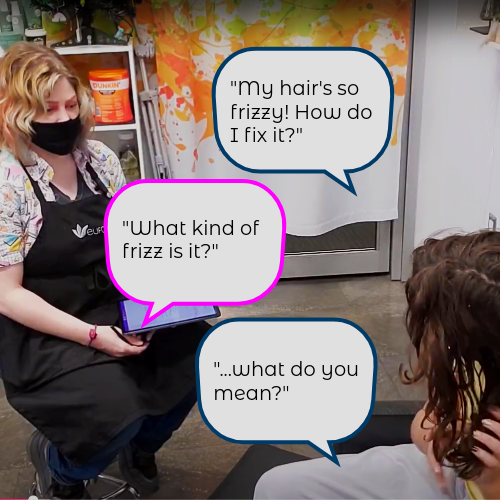
If you’ve ever Googled “how to stop frizz” and come back more confused than when you started, that’s not a you problem. It’s a framing problem. Frizz gets lumped into one category, when it’s actually several completely different things happening in your hair. Each has a different cause and a different fix.
Using a humidity-fighting anti-humectant on static frizz won’t work. Using a heat-drying technique on buildup frizz won’t fix it either. Trying to just flat iron away buildup frizz trades that frizz for more permanent structural damage frizz. Once you know which type of frizz you’re dealing with, the solution becomes obvious.
The Seven Types of Frizz
Humidity Frizz
This is the one New Orleans specializes in. Humidity frizz happens when moisture from the air enters the hair shaft, causing the cuticle to swell unevenly and lift. You walk outside looking great. Twenty minutes later, you’ve gained three inches of volume you didn’t ask for.
What it looks like: Puffiness, halo frizz (especially around the hairline), loss of curl definition, styles that looked finished indoors falling apart outdoors.
What causes it: The hair cuticle is porous. When humidity is high, moisture seeking (humectant) ingredients in your products actually pull more water in from the air, which makes things worse. This is the one case where you want to go the opposite direction: an anti-humectant.
Static Frizz
Static frizz is the opposite problem. It happens in dry air, like winter, heavy air conditioning like in hotel rooms. When there’s not enough moisture for electrons to dissipate, they build up on the hair strand and repel each other.
What it looks like: Individual strands standing up or floating away from the rest of the hair, or your head. Flyaways that point in every direction. Hair that clings to your clothes.
What causes it: Low humidity, synthetic fabrics, dry indoor heating, and over-brushing. Anti-humectant products will not help you here. You actually need to add a light layer of moisture or us a product with conductive ingredients. A tiny amount of a lightweight oil or a light cream is often enough.
Mechanical Frizz
This is often from a lot of well intended styling techniques that leads to physical disruption to the cuticle. Maybe you slept on it at a weird angle against a cotton pillowcase, or wet. Wear a lot of hat. Pulled a turtleneck up over your head. The cuticle is raised and sticking up, which latches onto neighboring hair where ever it found another open cuticle.
What it looks like: Frizz that is localized, often on the crown, around the hairline, or on whichever section of your hair was against the pillow. If the whether felt the same and you’ve ruled out humidity, but your doesn’t look as smooth as it did the day before.
What causes it: Cotton fabrics, tight elastic bands, friction. The fix might be refreshing one of the products in your routine, and re smoothing through it, or re blow dry finish it.
Structural Frizz from Protein Loss or Damage
This one gets misread constantly. When the hair shaft loses structural integrity, be it through damage, chemical processing, heat, or hard water mineral buildup, the cuticle doesn’t lie flat the way it should, even in a controlled environment. This isn’t frizz from the weather or your pillow. It’s frizz that’s baked into the condition of the strand itself.
What it looks like: Persistent frizz that doesn’t respond to anti-humidity products, rough texture, lack of shine, and hair that feels dry no matter how much you moisturize. Often confused with high porosity (which is freqently just damage) or “coarse texture”.
What causes it: Heat damage, chemical over-processing, mineral buildup from hard water (New Orleans runs around 138 ppm), color services without proper after-care, and stretching time in between appointments past what the hair can handle. The fix requires addressing the underlying structural issue with clarifying, treating, and rebuilding the hair’s integrity, not just layering more product on top.
Buildup Frizz and Formula Mismatch
This is the type that gets misdiagnosed most often, and the one that sends people in entirely the wrong direction. It happens when the hair has absorbed and accumulated so many synthetic ingredients, (film-formers, non-water-soluble silicones, heavy polymers, raw oils, microplastics, waxes, shae butter, etc) that it no longer behaves like itself. The strand can’t open and close properly. Moisture can’t move in or out correctly. The hair responds to humidity erratically because it’s baseline has been completely overridden.
You’ll often hear this described as “over-proteinization”: the idea that the hair has had too much protein and is now stiff, brittle, or frizzy as a result. That framing has spread widely in curl communities, and it’s led a lot of people to cut protein out of their routine entirely, or have 3 different products in the shower to cycle through trying to balance moisture with protein based on the day. But protein usually isn’t the problem (unless it’s synthetic), the formula as a whole is. The products being used weren’t the right match for that hair type, and the accumulation of everything in those formulas (not just the protein) is what’s causing the disruption.
Raw oils compound this problem significantly. When raw oils (as a category) are applied directly to hair over time, they penetrate the cortex and displace the water and protein that should be there, altering how the strands responds to moisture and styling. The result looks almost identical to synthetic buildup frizz from the outside, which is part of why both get lumped together and misdiagnosed.
What it looks like: Frizz, dryness, and curl separation that doesn’t respond to styling products. Hair that feels coated, stiff, or gummy at different times. Curl pattern that has changed or become unpredicatable. A sense that nothing works anymore, even products that used to.
What the fix actually looks like: This is not a one-appointment reset. A proper clarifying service is the necessary first step, it removes the surface and mid-shaft accumulation that’s interfering with everything else. But when the hair has been accumulating the wrong formulas and raw oils for months or years, the full resolution takes time. Realistically 6 – 12 months of consistent use of the right products, ones actually formulated for your hair type, alongside regular cleansing is what it takes for hair to fully behave like itself again. Some of that timeline is simply waiting for clean, well-treated new growth to replace what was compromised.
I don’t mean that to sound discouraging, it’s just honest, and it’s worth knowing before you spend another year cycling through products looking for the one thing that fixes it overnight, and maybe one more thing to add to the drawer of bad decisions that don’t work out.
Smoothing Treatment Damage (The sneaky one)
This one deserves its own category because it doesn’t fit cleanly into any of the others, and that ambiguity is exactly what makes it so hard to catch.
Certain smoothing treatments, including Brazilian Blowouts and Keratin Treatments, have been flagged by curl specialists and curly-haired clients for years as a source of long-term frizz and curl pattern disruption. The pattern is consistent: the treatment works beautifully at first. Frizz is gone. Hair is smooth. Then, over months, the frizz slowly returns, often worse than before. Another treatment is needed to manage it. The cycle repeats and cumulates. At some point, the curl pattern that was there before the first treatment isn’t quite coming back.
I will be honest, I don’t know exactly why this happens. It could be the heat required to seal the treatment in, high and repeated. It could be the synthetic proteins or polymers in the formula interacting with the natural curl bond in ways that aren’t fully understood. In the case of formaldehyde-containin formulas, there’s a chemical component that has it’s own well-documented effects on the hair and scalp. Most likely, it’s some combination of all of these things together. What we don’t know is the exact mechanism, because of the brands that make these treatments have largely denied the pattern exists or attributed it to application technique, which means no one with a financial stake in the answer has bothered to study it properly.
What it looks like: a frizz that builds back gradually after each treatment cycle, a curl pattern that has softened or changed, and a dependency on the treatment to manage the hair and help it behave, rather than being improved by it. It’s sneaky precisely because there’s a lag. The treatment looks like a solution. The damage shows up later, slowly, in a way that’s easy to attribute to something else.
What the fix looks like: Similar to Type 5: Clarifying, rebuilding, and time. But because the underlying cause isn’t fully understood, the recovery is less predictable. Some clients see their curl pattern return substantially. Others find the change is more permanent. The most important step is stopping the cycle before treatments compound whatever is already happening.
This is why I don’t offer keratin treatments or Brazilian Blowouts at Wicked Hues. If you’re looking for frizz relief that doesn’t come with a long-term trade-off, there are options that work with the hair’s chemistry rather than overriding it.
Oxidative Damage Frizz
This one affects far more people than realize it, because most of them don’t think of what happened to their hair as a chemical process.
Oxidation happens when the hair’s internal structure is altered by exposure to an oxidizing agent. Professional hair color uses it deliberately: the developer opens the cuticle and the alkalizing agents in the formula allow pigment to enter or lift out. But the variables in any color formula (the percentage of alkalizing agents, the size of the pigment molecules, how much of the formula penetrates versus sits on the surface as a coating, the developer strength, and how synthetic or naturally derived the ingredients are, all affect how much structural impact the process has on the strand. This is true of any color service, from any formula, at any price point. It’s also why the color line a stylist uses matters. It’s not just chosen for results, but for the remaining integrity of the hair that it’s been used on.
Here’s where it gets important: oxidative damage isn’t only caused by professional color. It’s not always caused by box dye. It’s caused by anything that triggers an oxidative reaction in the hair, and that category is much wider than most people account for.
If it lightens, lifts, or alters your hair’s color or texture, it’s a chemical process. That applies to box dyes and professional dyes, yes, but it also applies to Sun-in sprays, shampoo-in color, lemon juice mixed in a kitchen, vinegar rinses or baking soda used for “natural lightening”, any DIY combination someone found on social media, and every other at-home approach that achieves a color change. The reason lemon juice lightens hair is the same reason developer lightens hair: oxidation. The chemistry doesn’t become safer or less damaging because the ingredient came from a fruit. People reach for alternatives because they fell like they’re avoiding harsh chemicals, but the mechanism is the same, and in many cases, the pH and acid content of DIY mixes are harder on the strand than a properly formulated professional product.
Then there’s natural oxidation, which happens to everyone, whether or not they’ve ever touched a color product. UV exposure oxidizes the hair shaft over time. This is why the ends of long hair get lighter as the hair grows: the ends have had more cumulative sun exposure than the roots. People call it “sun bleaching” or “sun lightening” and treat it as a cosmetic bonus rather than what it actually is: chemical damage. The hair is losing pigment because the structure is being broken down by UV radiation. The longer the hair, the more oxidative history those ends are carrying.
Chlorine belongs in this conversation, too. Chlorine and bleach are chemical cousins. Both are oxidizing agents, and chlorine from pool water interacts with the hair shaft in ways that compound existing oxidative damage, strip the cuticle, and accelerate protein loss. If you’re swimming regularly and wondering why your hair isn’t behaving, chlorine exposure is almost certainly a contributing factor.
What oxidative damage looks like on the hair: frizz and dryness that concentrate towards the ends, loss of elasticity, or color that fades faster than it should, and a texture that feels rough or straw-like despite conditioning. Because it accumulates gradually, and so many people don’t connect their DIY lightening, regular pool swims, or sun exposure to a chemical process, it often presents as mystery frizz that nothing seems to fix.
What actually helps: UV protection on the hair is not optional if you’re spending time outdoors, it’s the equivalent of sunscreen, and it’s something most people skip entirely. Stopping the DIY oxidative processes matters, too. And for hair that’s already carrying significant oxidative damage, protein-focused treatments that rebuild structural integrity are the repair path. Not just more moisture or replenishing the deteriorated lipid layer.
Going Deeper on Humidity Frizz: The Two-Part Fix
Because humidity frizz is the one most people in this city are fighting year-round, it deserves a closer look. There are actually two separate things that help and you need both.
Part One: Dry Your Hair All The Way
This one surprises people. When hair airdries (or partially air dries) the cuticle has a chance to swell and set unevenly as the water slowly leaves the strand. That uneven movement is actually a significant contributor to frizz. When you blow-dry your hair completely using dry heat, you’re sealing the cuticle in a closed, smooth position until the hair retains warmth.
The goal is to get the hair to 100% dry, not “dry enough” not “I think”. Hair that feels dry but is still holding even a small percentage of moisture will continue to move and frizz as that last bit of water escapes, especially the moment it contacts humid outside air. Fully dried hair that retains warmth is far more stable.
Part Two: Use the Right Anti-Humectant Styler
Once the hair is fully dried, the goal is to keep external moisture from re-entering the cuticle. This is where anti-humectants come in. Unlike humectants (which draw moisture towards the hair), anti-humectants create a barrier that blocks the cuticle from absorbing humidity from the air.
This is important: in a humid climate, many popular curl creams and stylers are loaded with humectants like glycerin. In the right climate (low to moderate humidity), glycerin is probably great! In New Orleans in July, glycerin is working against you. It’s actively pulling moisture in and expanding the cuticle all day long.
The Bottom Line
Frizz is not one problem. The fact that we treat it like one is why most people cycle through products that work sometimes, don’t work other times, and can never quite figure out why.
Identify the type of frizz you’re dealing with first. Then choose the tool that actually addresses the mechanism. That’s the approach that holds up, whether it’s June in New Orleans, or anywhere else.
- Exploring Scalp Relief & Revival: Oily by Day Two, Flaky by Day Three: What I Actually Do About It
- Yes, You Can Ask Me Not to Talk. Here’s What Else You’re Allowed to Ask For.
- Diffusing Your Curls and Still Getting Frizz? Here’s What’s Actually Going Wrong
- Flaky Scalp? Here’s Why It’s Probably Not Dandruff (And Why Treating It Like Dandruff Makes It Worse)
- Not All Frizz Is Caused By Humidity – And That Changes How You Treat It
